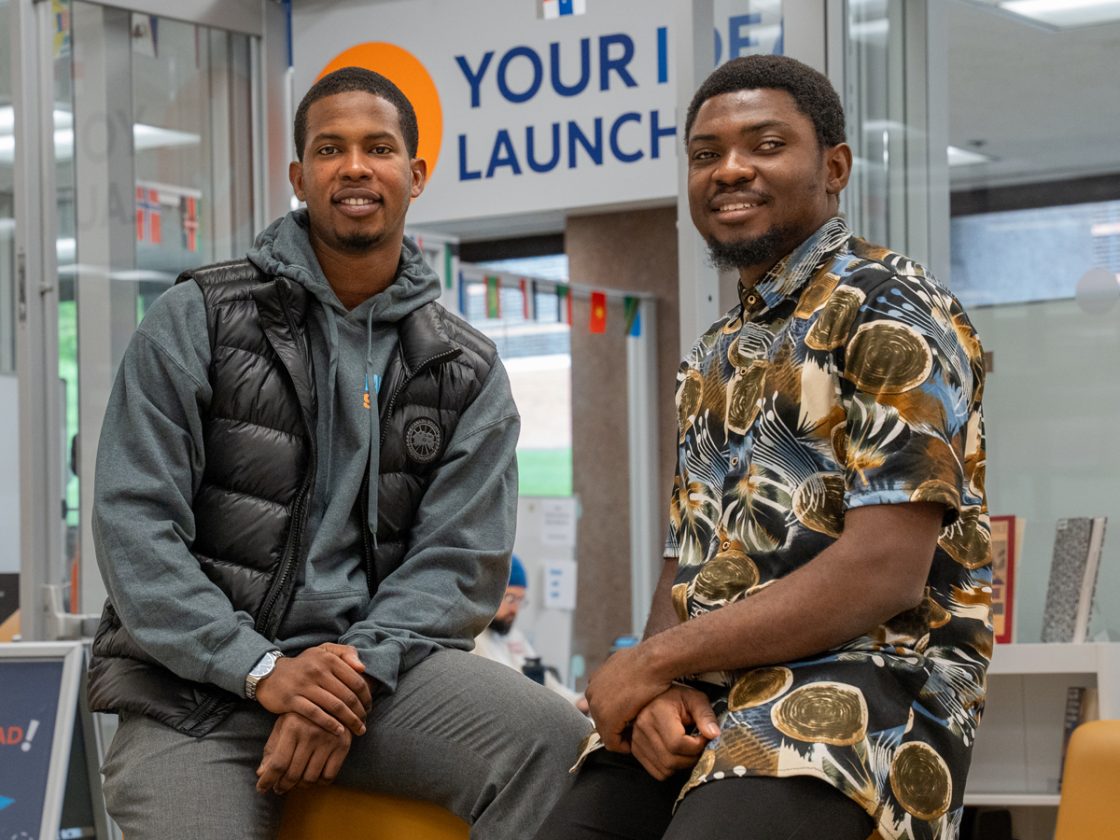
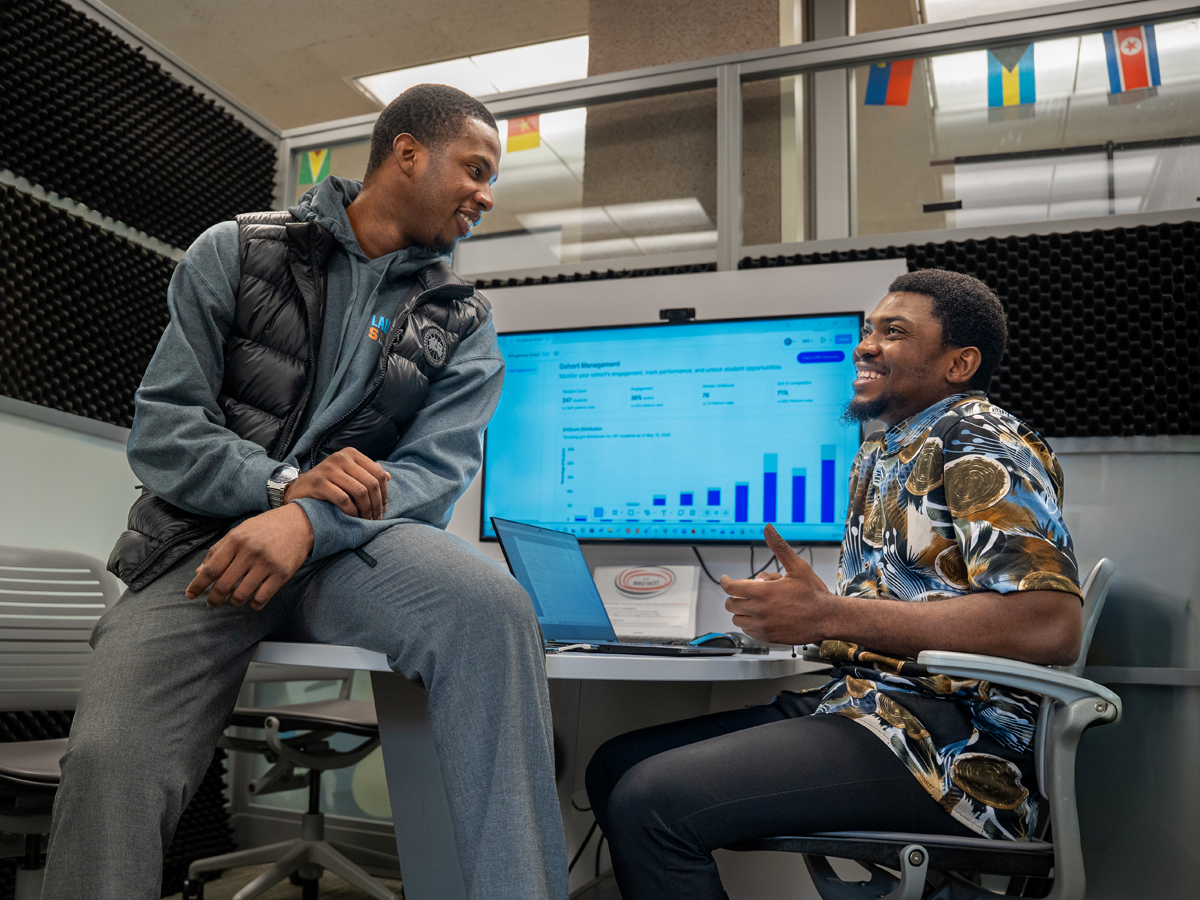
Edouard Agbor (right) founded GritGateway, an AI platform that connects African students with verified academic and funding opportunities across the continent and the world. He’s pictured with teammate Souleymane Bah. (Photo by Amy Manley)
From Scam Victim to Pitch Winner: Student Builds GritGateway
Edouard Agbor has spent years building a solution to a problem he knows intimately.
Growing up in Cameroon, he watched talented students lose access to life-changing educational opportunities—not because they weren’t qualified, but because the system designed to help them was broken, expensive and often predatory.
A first-generation student, Agbor’s parents did not attend university. He was unprepared to navigate a complex education system alone and, like so many promising students, fell victim to scam.
“I lost over $800,” says Agbor. “That money took me over a year and a half to save.”
Inspired by his experience, Agbor, a graduate student in applied human-centered AI in the School of Information Studies, founded GritGateway, an AI platform that connects African students with verified academic and funding opportunities across the continent and the world.
“I started building the system for two reasons: so that nobody would have to be in my shoes, and to collect information that will permit the continent to get ahead,” says Agbor. “Instead of just mapping to academic excellence, what about the talents that these people have? Can it open the door? We increase their chances of getting a scholarship, fellowship and getting access to those funds without being scammed.”
A Platform Built on Personal Experience
GritGateway’s matching engine uses a psychometric model called GritScore that measures resilience, resourcefulness and experience rather than GPA alone. The platform hasn’t formally launched or spent any marketing dollars and has already attracted 1,000 student users across more than 25 African countries.
Agbor is confident the technology works because he used it to advance his own education. It was the GritGateway tool that suggested Syracuse University would be a good fit for him, given his interests in AI and entrepreneurship and such resources as the LaunchPad at Syracuse University Libraries. He’s been a regular at the LaunchPad since he arrived on campus in January. That’s where he connected with teammate Souleymane Bah ’26, a then-senior in the Maxwell School of Citizenship and Public Affairs. Bah believed in his venture and helped him share, pitch and grow the idea, freeing Agbor to continue to develop and test features.
“I’ve been so impressed with how this team has refined their business development plan, but even more impressed with the tremendous amount of work they’ve put into the service and how they’ve leveraged AI tools,” says Traci Geisler, director of the LaunchPad. “This venture has identified and addressed not only a gap in service but a true need. The interest in this product has been amazing and just continues to grow.”
Putting It to the Test
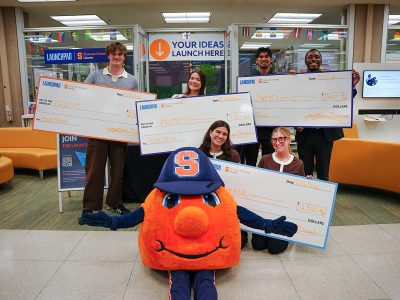
Agbor and Bah are not the only ones who believe in this idea. The team won several entrepreneurship competitions this past spring, including the Lerner Center Social Impact Pitch Competition, where GritGateway took home the top prize of $5,000.
The competition, now in its second year, is hosted by the Lerner Center for Public Health Promotion and Population Health in partnership with the LaunchPad. This year’s theme—Building Healthier Communities Through Innovation—drew 12 undergraduate teams from eight of the University’s schools and colleges, competing in a two-round format evaluated on problem-solving, viability, research and development, and social impact.
Other winners of the Lerner competition include rising senior Ava Ray Lubkemann ֶ’27, an environmental engineering student, in second place. Lubkemann won $3,000 for a mobile thrift model built around a converted bus that collects donated clothing and redistributes it to underserved communities.
Taking home third place and $1,000 was Haley Greene ’26, who graduated in May with a degree in advertising and applied communication from the S.I. Newhouse School of Public Communications, for a digital platform called Miirror that reimagines eating disorder recovery.
Vicente Cuevas, the Lerner Center’s undergraduate student engagement manager, says this year’s competition showcased exactly the kind of thinking it was designed to encourage. He says, “This competition is an opportunity for students to move from idea to action, and to see themselves as changemakers capable of building healthier communities through innovation.”
What Comes Next
All three teams are reinvesting their prize money in their ventures to support continued growth. Agbor and Bah plan to bring GritGateway to scale through new partnerships, while Bah will remain at Syracuse to pursue an M.P.A. at the Maxwell School.
Later this month, the system will launch a dedicated environment for African universities, high schools and nongovernmental organizations to support their students on the platform. Agbor projects 10,000 users by September, and plans are in development to open access to U.S. universities interested in recruiting African talent.