Artificial intelligence (AI) is already making substantial changes in every industry, shifting how we work, learn and organize our daily lives. But how can AI tools shape the field of building science? That was the central question at the Industry Summit on Artificial Intelligence for the Built Environment, organized by Bing Dong, Traugott Professor of Mechanical and Aerospace Engineering in the College of Engineering and Computer Science and co-director of the Syracuse Center of Excellence in Environmental and Energy Systems (SyracuseCoE).
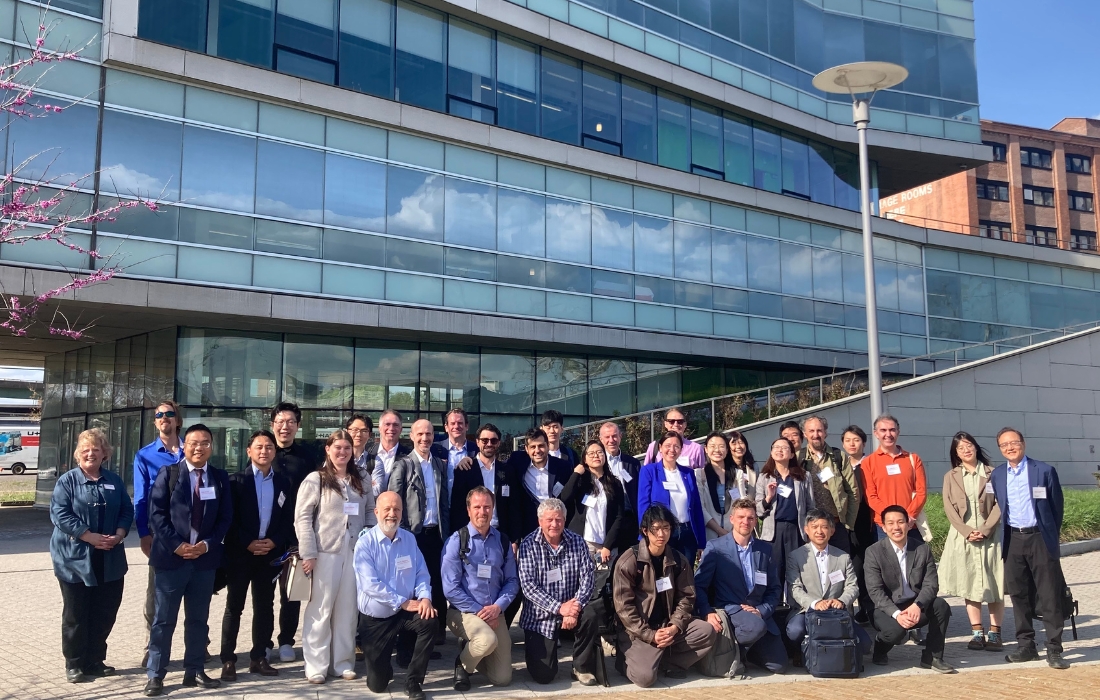
Structured as a working session, the May 4 summit featured expert panelists from industry, academia and government agencies, with 12 companies represented and a total of 35 participants. After opening remarks from Professor Dong, the first panel of the day explored AI applications in smart and human-centered buildings. Presentations included:
- From Equipment to Ecosystem: An AI Strategy for Thermal Energy Systems and the Built Environment, presented by Josiah Johnston, senior director of data science at Daikin Open Innovation Lab Silicon Valley
- AI in Buildings: A Perspective From the Field, presented by William Healy, senior director at TRC Companies
- Using AI for Building Optimization, presented by Evan Torkos, vice president for strategy at Nantum AI
- The Restoration of a Building or Home’s Comfort, a New Set of Opportunities With AI, presented by Michael Birnkrant, chief architect, service and aftermarket at Carrier Corporation
A moderated discussion led by SyracuseCoE’s executive director, Jianshun “Jensen” Zhang, gave attendees a chance to dig deeper into these AI advances before breaking for a student poster session and lunch.
The afternoon panel widened the lens to AI’s role in building-connected infrastructure, covering the following topics:
- Load Flexibility and Electrified Commercial Buildings, presented by Mark Bremer and Julia Griffith from National Grid
- Hallucination of AI in Critical Infrastructure, presented by Herbert Dwyer, founder and CEO of EMPEQ
- A Semantic Foundation Unlocks Rapid Deployment of AI in the Built Environment, presented by Andrew Rodgers, co-founder of ACE IoT Solutions
- AI-Powered Communities: From Data to Resilience, presented by Nancy Min, co-founder and CEO of ecoLong
- Using GenAI to Accelerate Decarbonizing NYC Commercial Real Estate, presented by Thomas Yeh, consulting technical advisor, NYSERDA
The summit concluded with small group discussions: four breakout groups each co-facilitated by Syracuse University faculty and populated with a cross-section of academic and industry voices. This format ensured that the day’s themes were stress-tested in conversation and built the foundation for future collaborations. Dong plans to apply for funding for an interdisciplinary research center, such as a National Science Foundation Engineering Research Center, that will advance university-industry partnerships in the healthy buildings field.
The summit made clear that AI’s role in the built environment is no longer speculative—it is operational and growing rapidly. From smarter HVAC to grid-scale flexibility to community resilience, the challenge now is deploying these tools thoughtfully, sustainably and at scale.
This event was supported by the University’s Office of Research through their Team Building for Large, Collaborative Grants program.
To be notified of future events and opportunities, sign up for SyracuseCoE’s email list or follow them on LinkedIn.