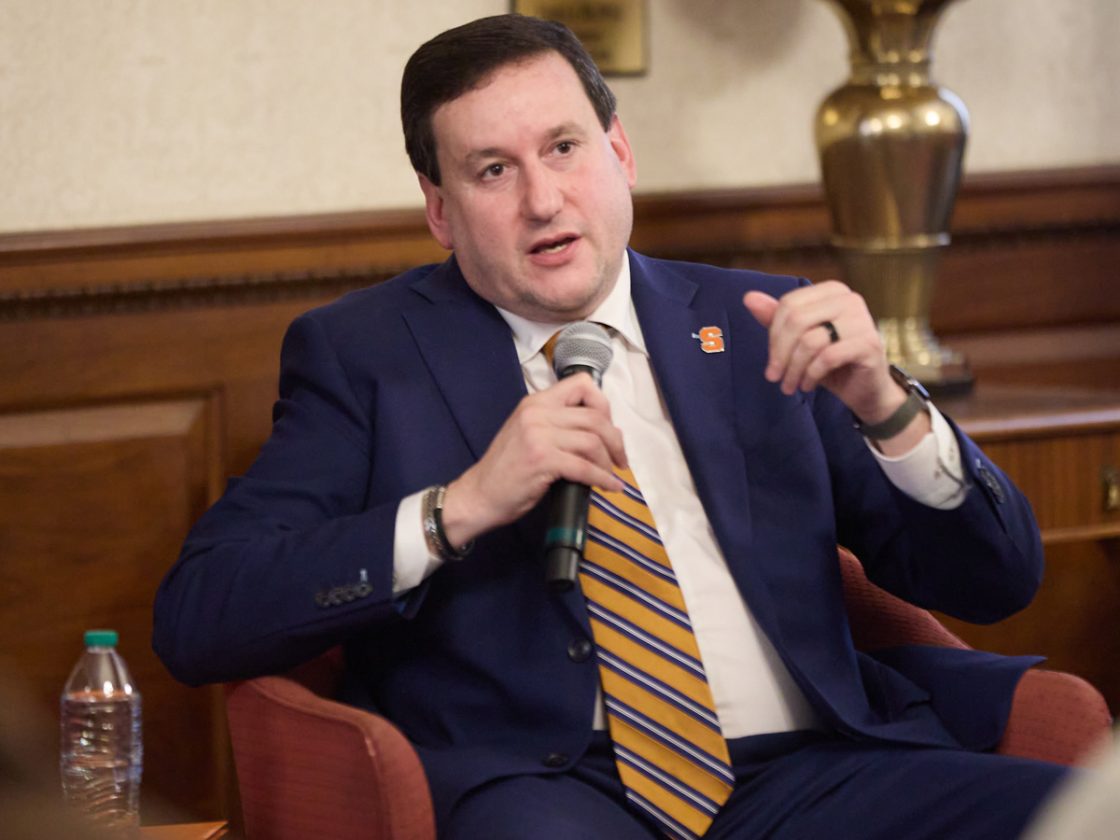
Rubin speaks with a packed Founders Room crowd of students, faculty and staff on the current AI landscape. (Photo by Chuck Wainwright)
4 Ways Jeff Rubin Is Thinking About AI Right Now
Ask Jeff Rubin what keeps him up at night about artificial intelligence and you won’t get a single answer.
The University’s senior vice president for digital transformation and chief digital officer is tracking several threads at once: how AI can reshape higher education, why the job market isn’t collapsing the way headlines suggest, what it will take to rebuild trust in online content, the need for regulation and where the University’s massive stores of data fit into all of it.
Rubin shared some of his recent thinking as a panelist at a Maxwell School fireside chat on digital transformation and AI in New York state. Here are four takeaways.
Despite recent headlines about mass layoffs, Rubin argues the data tells a more nuanced story. He pointed to Gartner research finding that less than 1% of the 1.4 million layoffs tracked in 2025 were attributable to AI.
He compared the moment to the mid-1990s, when the commercialization of the internet changed what people could accomplish in an eight-hour workday. Work didn’t disappear; it shifted. AI, he says, is the next version of that shift.
Those who don’t learn to incorporate AI into their field will find themselves at a disadvantage, Rubin says—and that applies to every discipline, not just technical ones.
That’s part of why he’s pushing for digital literacy to become a standard part of a liberal arts education.
“We need humanities, we need social science, we need math,” he says. “But where’s digital literacy?”
Rubin was candid about the current crisis of trust around AI-generated content. He described himself as someone who lives and breathes AI daily yet still struggles to tell real media from fabricated material.
“I feel like I’m the most gullible person because when I read something or my kids send me something, I don’t know if it really happened or not,” he says. “And so now I’m spending my time trying to verify information.”
The flood of low-quality, machine-generated content online—“AI slop”—is significant, but he says it’s solvable. He pointed to ideas like watermarking verified media or blockchain-based content verification, though he noted that solutions will need to work at a global scale, not just a state or federal one.
Closer to home, Rubin says the University is trying to lead by example. When Syracuse builds a new tool—such as its new AI-powered class search tool, Clementine—he wants users to see how it works, what it can answer, what it won’t and what guardrails are in place.
“Transparency and responsibility are going to be a big part of this,” Rubin says.
When asked what excites him most about AI’s potential, Rubin zeroed in on data. For decades, institutions like Syracuse have built data systems that serve individual functions well—enrollment data, alumni data, class data—but don’t always connect to one another.
“AI is not afraid of data,” Rubin says. “The more you can give it, the better it’s going to be.”
When those data silos are combined, the possibilities shift. The University could leverage the siloed data, with AI’s processing capacity, to ensure students aren’t slipping through the cracks, help them find the right courses and clubs and engage alumni in more meaningful ways—just to name a few potentials.
Rubin didn’t shy away from the impact of AI’s environmental footprint. Data centers require massive amounts of energy, and the demand is growing faster than the clean energy infrastructure needed to power them.
“Over the next five to 10 years, we are going to use a lot of carbon to build our data centers and keep up with the demand,” he says.
Building out cleaner energy sources—such as nuclear power—takes time, potentially a decade or more. In the interim, Rubin says, the industry will need to develop more energy-efficient AI models that require less computing power to run.
It’s a tension Rubin acknowledges plainly: the technology that promises efficiency gains is itself an enormous energy consumer, and the path forward requires both better infrastructure and better engineering.
“These are very active policy conversations that are happening right now,” he says.
To learn more the University’s AI efforts, visit the Information Technology Services website and subscribe to the bi-weekly AI Insights newsletter.