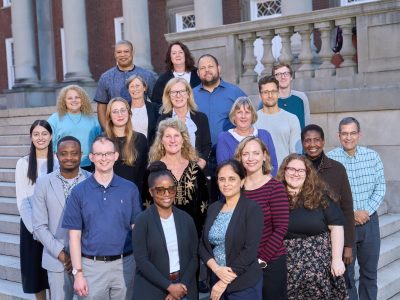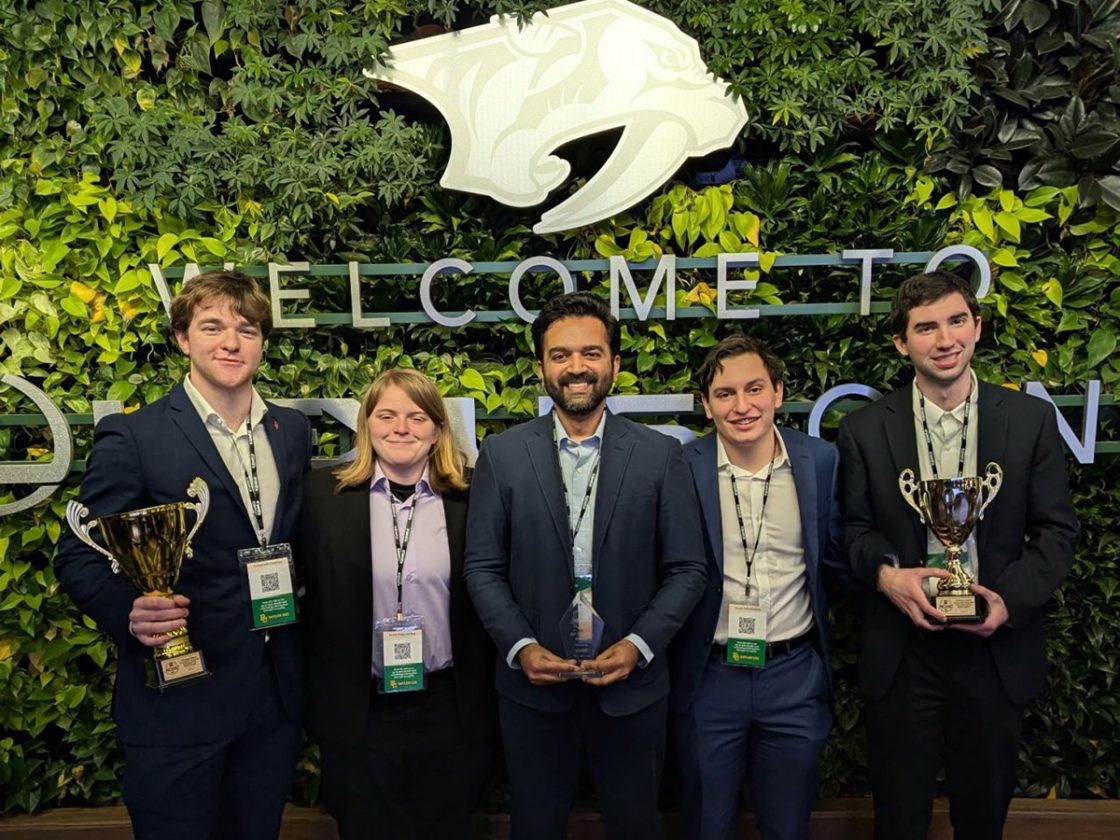
From left, Daniel Griffiths. Jessica Fackler, Assistant Professor Hassan Rafique, Daniel Baris and Austin Ambler
Sport Analytics Team Claims National Collegiate Sports Analytics Championship
After years of podium finishes and back-to-back undergraduate team titles, the sport analytics program in the Falk College of Sport has made winning at the National Collegiate Sports Analytics Championship (NCSAC) into a habit. This year, the program didn’t just return to the top—it dominated.
Senior Austin Ambler captured the overall undergraduate individual title, and the team of Ambler, Daniel Griffiths and Daniel Baris claimed the undergraduate team championship, with all three landing in the top 10 in overall points.
For the four sport analytics majors who made the trip, Ambler, Griffiths, Baris and Jessica Fackler, the result was the payoff of a disciplined, collaborative preparation process built around one guiding principle: do the work before you ever step in the room.
“Winning the overall undergraduate individual title was incredibly rewarding,” Ambler says. “The competition featured so many talented and high-performing students, so being named first among them is something I’m truly proud of. It validates the hard work, preparation and support system that went into getting to that moment. Representing Syracuse and Falk College means a great deal to me.”
Preparation Was Key
The students’ preparation was shaped by weekly sessions with Assistant Professor Hassan Rafique, who led the group through practice data sets, varied prompt scenarios and repeated five-minute presentation drills in the months leading up to the competition.
“This year’s team had strong analytical skills and was eager to discuss how to improve,” says Rafique. “The students were very engaged in discussing strategies to optimize their points. We had a good plan going into the first day of the championship. However, some delays and obstacles forced us to improvise, and the students did an amazing job of maintaining their composure and persevering throughout the day.”
Rafique’s teaching emphasizes not just technical proficiency, but the ability to communicate findings clearly and persuasively under pressure.
“The weekly preparation sessions with Dr. Rafique completely changed how I think about data storytelling,” Griffiths says. “The check-ins and iterative feedback meant that by the time we got to competition weekend, we weren’t starting from scratch, we were refining. That preparation gave us a massive advantage compared to teams who were building everything last-minute.”
Fackler described a similar transformation in how she approached the competition’s core challenge.
“I originally had a completely different perception of what the competition was about,” she says. “Those sessions made me quickly realize I needed to pivot. They taught me that I needed one simple idea and basically sell it to the judges.
Competition Strategy
Beyond the preparation, the Syracuse team arrived in Nashville with a collective strategy for the competition weekend itself. NCSAC features not only the signature presentation competition but also a series of side events and challenges, and the four students approached each one with intention.
“The team dynamic was both competitive and highly collaborative,” Griffiths says. “We pushed each other internally to be better, but we were also very intentional about optimizing how we worked together.”
For Ambler, the hours of weekly preparation paid dividends from the first moments of competition.
“I immediately felt my preparation click into place once the competition began,” he says. “Elements from my practice presentations translated directly into my final delivery, and having a strong foundation from the practice data, study guide, and weekly prep sessions allowed me to start confidently. This head start let me focus on refining and building upon my presentation rather than starting from scratch, which made a noticeable difference in my performance.”
For Baris, the competition’s most memorable moment came from watching his own growth across rounds. “What stands out the most to me is probably my presentation,” he says. “I felt like it improved every time I presented it as I got more and more comfortable.”
Griffiths found his most striking moment in the broader picture of what NCSAC represents. “The moment that stood out most was realizing, right before my presentation, just how diverse the field of sports analytics really is,” he said. “Seeing 50-plus students compete with backgrounds in marketing, engineering, business, fan engagement, it made the experience feel bigger than just the competition itself.”
“Beyond the win, I hope students leave with confidence that they can tackle complex, real-world problems and compete at a high level,” says Rafique. “Experiences like this build resilience, teamwork and the ability to communicate ideas clearly under pressure. I hope they see themselves not just as students completing a project, but as emerging professionals who can meaningfully contribute to the field of sports analytics.”
Griffiths offered a challenge to the next generation of Falk competitors. “It takes more than just coding and analytical skills to compete at this level,” he says. “It requires determination, adaptability and the courage to make decisions under uncertainty. This competition is designed to identify future leaders in sports analytics. If that mindset excites you, then this is absolutely the competition for you.”