VPA Students Bring the Legend of 44 to Life
When Brian Tarrant’s email arrived in the inbox of design faculty in the College of Visual and Performing Arts (VPA), it carried with it more than a simple project proposal. It carried the weight of history, the story of college football’s most famed number—the legendary 44—and those who wore it.
Tarrant ’96, a former Orange football player and senior vice president with MC2, a brand experience solutions agency, reached out to partner with the University. He sought help curating the memorabilia and developing the storytelling for the Legend of 44 exhibition, which his company designed.
The primary stakeholder, Rob Konrad ’02, the last Syracuse football player to wear the number before it was retired in 2005, invested a significant amount of time and personal resources to help acquire the iconic memorabilia. “His generosity and deep love for the University truly made this project possible,” Tarrant says.
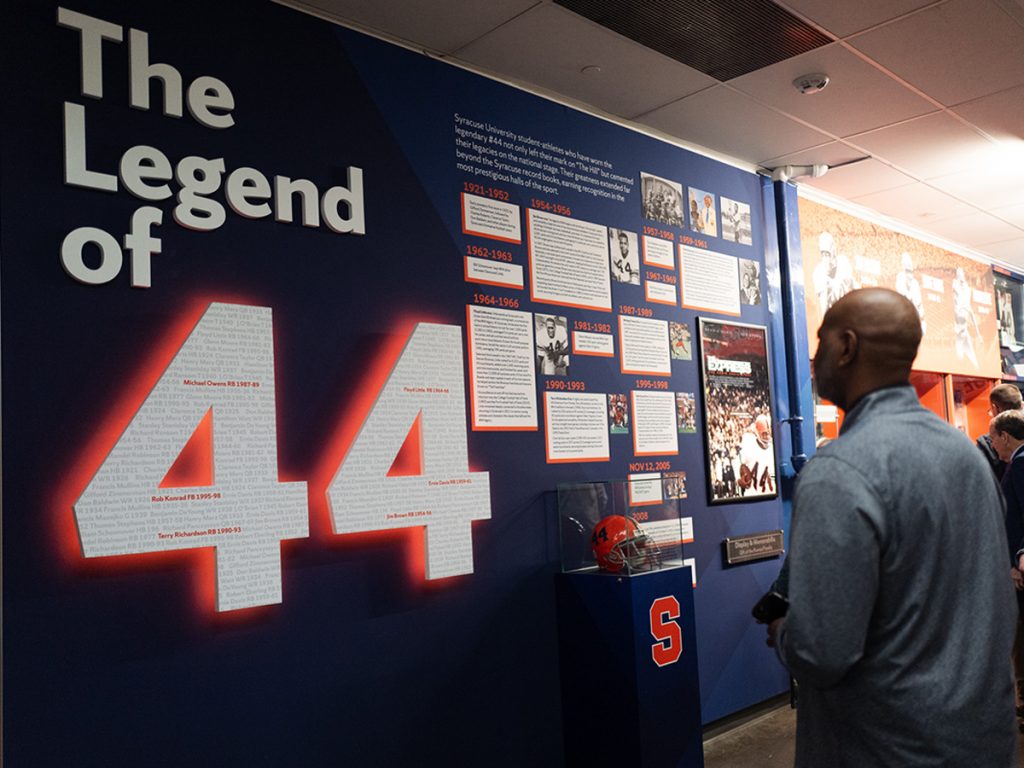
The number 44 is not just a jersey at Syracuse; it is part of the University’s identity. From 1954 to 1998, 11 players wore the number, beginning with Pro Football Hall of Fame running back Jim Brown ’57, who ushered in the modern era and transformed it into a symbol of excellence.
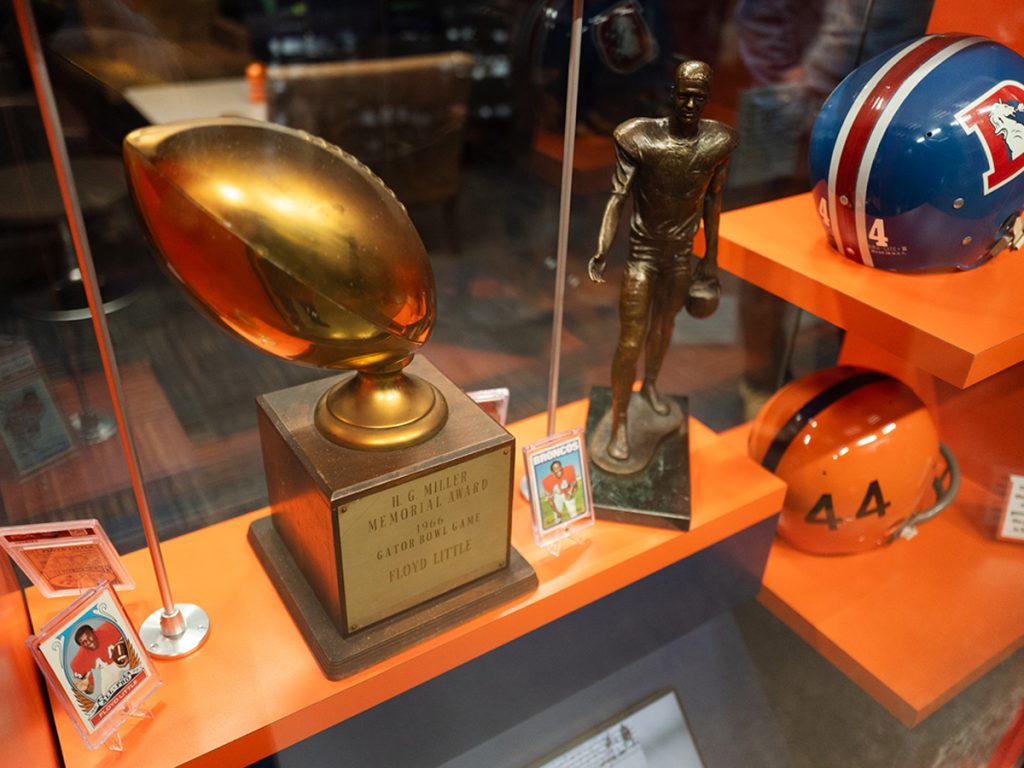
The most notable players to follow Brown include Ernie Davis ’62, the first African American Heisman Trophy winner in 1961; Floyd Little ’67, H’16, a three-time All-American at Syracuse and Hall of Fame running back with the Denver Broncos; Michael Owens ’90; Terry Richardson ’94; and Konrad, who went on to play six seasons with the Miami Dolphins.
Honoring the Legend of 44
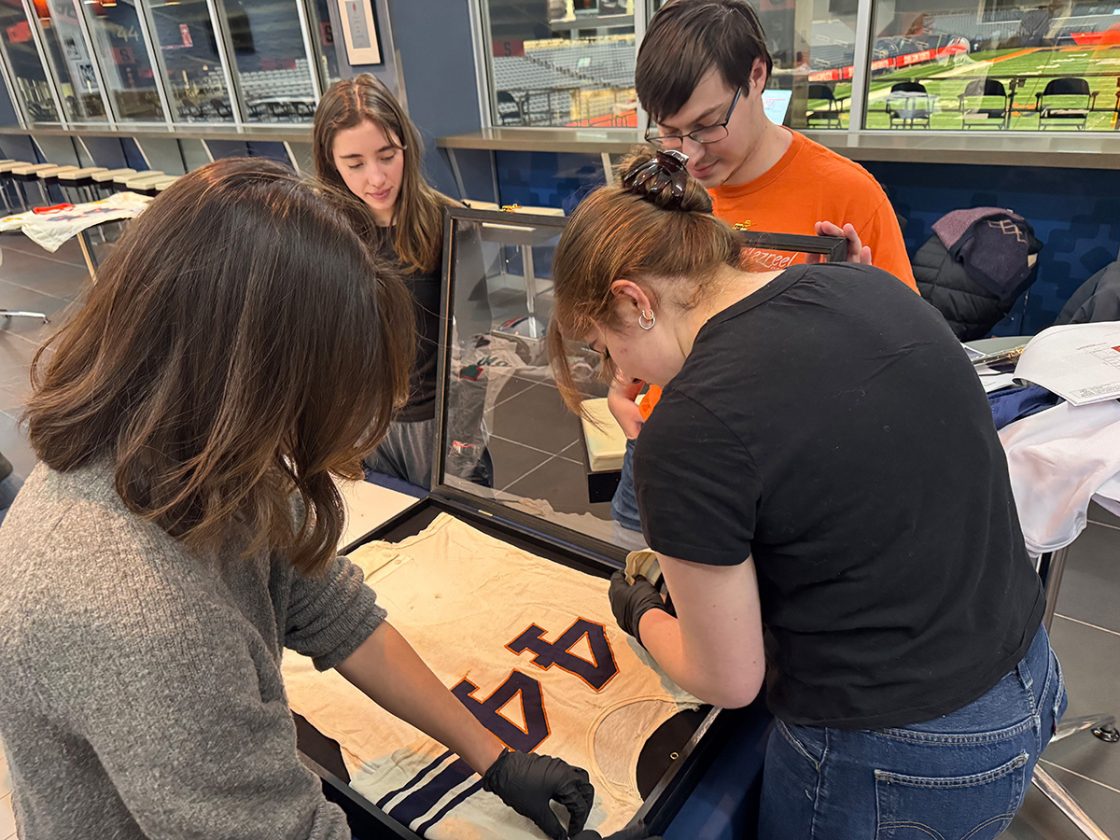
To create the exhibition, environmental and interior design students Trisha Mohta ’28, Katja Wetzel ’27, Carmela Garcia ’26, Isabel Lamporte ’26 and Holly Ishiro-Randall ’26—along with museum studies graduate student Daniel Griffaton G’26—worked alongside faculty members Zoriana Dunham, assistant teaching professor, Andrew Saluti, associate professor, and Tarrant and his team.
The students learned the stories behind the artifacts, including game-worn helmets from Brown and Konrad and cleats from Davis’ Heisman season. They visited the storage site to measure objects and examine them firsthand. The challenge was to translate decades of achievement, sacrifice and cultural significance into a cohesive narrative that would resonate with fans across generations.
Within the exhibition’s design, larger cases feature Brown, Davis and Little, and smaller cases feature Owens, Richardson and Konrad. A backlit 44 display lists all 25 players who were known to wear the number on the football field.
A Rewarding Experience for Students
As the project progressed, the team saw how individual stories wove together into something larger—a tapestry of excellence that transcended any single student-athlete. They collaborated through shared digital whiteboards, collecting sketches and concepts, refining their vision through multiple meetings with Tarrant’s team.
Garcia has focused on big-scale design in her studies, and this project taught her that human-centered design must prioritize the small scale.
“It was so exciting to see this project come to life within the course of a few weeks,” Garcia says. “And it made me realize the power of cooperation, various skills and a shared interest.”
Randall says the students were involved in the full design process. “For the first time, we were able to follow a project from initial ideation through installation, and I am proud to have been able to contribute to a project that celebrates Syracuse’s legacy,” she says.
“A particularly meaningful element for the students was shaping the ‘legend story’ of the iconic number 44,” says Dunham. “They worked to design a display that would connect fans across generations while preserving the legacy and significance of the number within the school community.”
When installation week arrived in mid-November, the students and faculty completed the hands-on work. The exhibition, now permanently situated outside Club 44 at Gate C in the JMA Wireless Dome, features the artifacts alongside a timeline honoring every player who wore the number, plus video and photo displays that bring the legacy to life.
“Working with students from the environmental and interior design and museum studies programs was an incredible opportunity,” says Tarrant. “The students assumed ownership of the storytelling, including image selection, artifact descriptions and overall layout, which became a major asset to the project’s success. I could not be more proud of this project and the role the students played in bringing it to life.”
The unveiling ceremony in November was attended by Konrad and William Schoonover ’65, who also wore the 44, along with the families of the legendary players and Chancellor Kent Syverud.
For Dunham and Saluti, watching their students succeed was deeply rewarding. “The students gained experience in artifact research, narrative development, client collaboration, iterative design and team project management,” says Dunham. “It is a rare opportunity for students to leave a permanent mark on campus while applying the skills they are learning—what could be more powerful than that?”