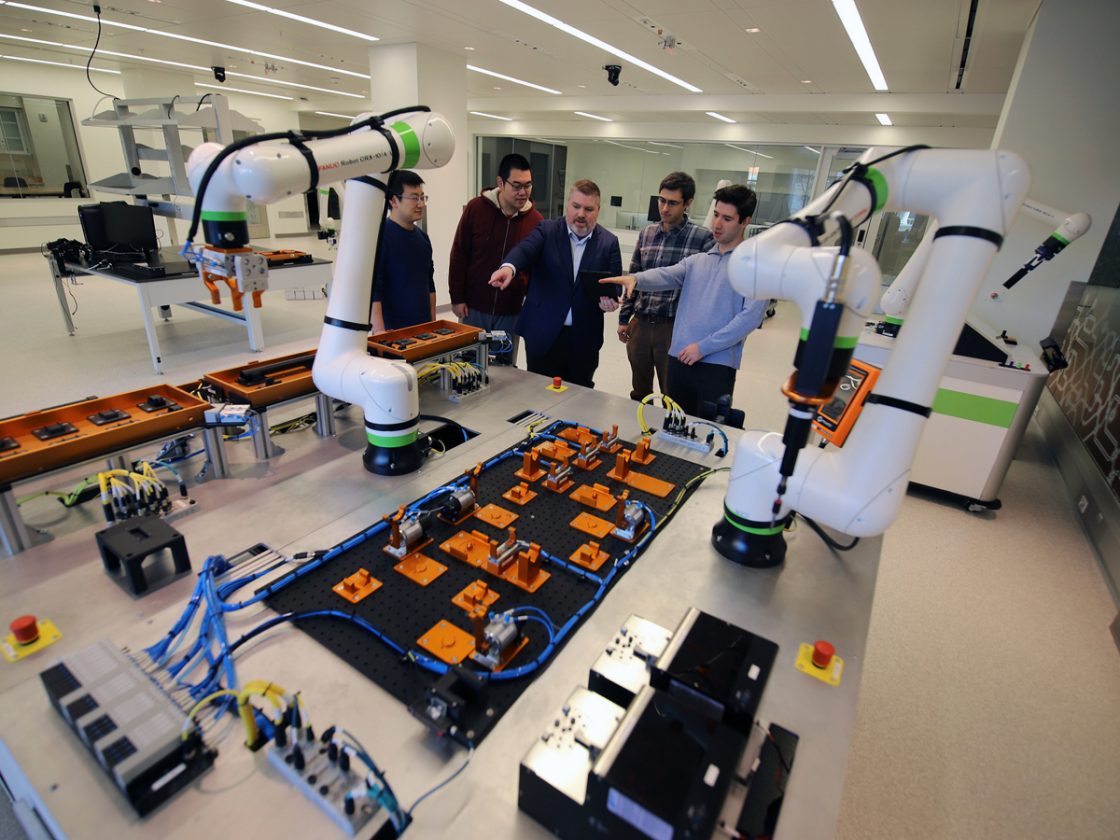
Mechanical and aerospace engineering professor Zhenyu Gan (left), civil and environmental engineering professor Yizhi Liu (second from left), electrical engineering and computer science department chair Alex Jones (center) and electrical engineering and computer science professor Garrett Katz (second from right) examine the autonomous manufacturing robots in the Center for Advanced Semiconductor Manufacturing with Brandon Lyubarsky ’26.
Why AI Can’t Replace Computer Scientists
When it comes to computer programming, AI is a valuable tool that can write, debug and optimize code on demand.
However, those tools don’t generate perfect code and can’t replace computer science professionals who possess the critical thinking and understanding of algorithms and complex system architecture needed to write effective code, says Alex Jones, the Klaus Schroder Endowed Professor for Engineering and the electrical engineering and computer science department chair in the College of Engineering and Computer Science.
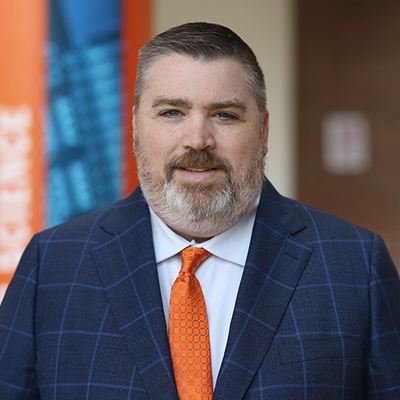
“Students can use AI tools to help them generate code structures and skeletons, but that’s not a replacement for understanding the foundations of computer science and troubleshooting the issues you encounter,” says Jones, a fellow of the Institute of Electrical and Electronics Engineers.
Recently, Jones helped secure $4.5 million in research funding in AI hardware acceleration, semiconductor design and workforce development. Enhanced hardware resources, combined with cutting-edge AI research on campus, set students up for success through access to industry-scale and industry-grade large language models, foundation models and other types of AI being developed, Jones says.
“We are constantly trying to find ways to integrate new ideas into the courses that we offer, while looking at ways that we can offer relevant and topical content with a technical depth that makes it useful in the field,” Jones says. “Our programs immerse students in the different forms of AI, looking at the AI approaches and the types of hardware designs that are important to run these efficiently.”
Jones sat down with SU Today to discuss how Syracuse’s approach prepares students to not just use AI, but to build the next generation of AI breakthroughs.
Our goal is to help educate software scientists and hardware engineers on what AI is, the many types of AI approaches out there and how they can be used properly and efficiently. There are challenges anytime you have a technology that has developed fast, where you’re constantly pushing the envelope of what it can do.
Our graduates are equipped to help identify and shape how this technology can move forward responsibly, efficiently and ethically, and they can be part of building the next generation of AI approaches. There’s a huge opportunity to make improvements to these AI tools, to make them more efficient and able to solve problems they can’t currently solve, without having to absorb as many resources as they currently do.
We have classes that talk about the different forms of AI, everything from natural language processing to deep language learning and agentic AI. We’re teaching students how to write programs using open AI and other application programming interfaces (APIs). Then there’s understanding algorithms, discrete mathematics and finite automata. These are all skills that are not specifically related to AI but are part of the computer science theory background that are helpful and important when you want to write effective software.

Our students understand questions like what does it mean to have something with this kind of complexity? When is it OK to use this? How do I parallelize something without increasing its complexity? Those are foundational computer science concepts that go beyond basic Python programming.
Computer science has always operated that way. If you look at Moore’s Law—the speed and capability of computers can be expected to double every two years—that’s growth at an exponential rate. So, how do our students live on an exponential curve? How do they take advantage of exponential technologies? They learn the underlying principles of the skills today so they can use continuous learning and education to stay current with the latest technologies. That’s what will make you a successful computer scientist.
We also keep a lot of the same disciplines under the same roof. Electrical engineers can easily take computer science classes. There’s so much richness in the availability of classes. If you have an interest, you can customize what you study to make yourself a unique and sought-after graduate, and that differentiates Syracuse from other places.